
Checking Chattahoochee County Criminal History
There is no single public database that contains every Chattahoochee County criminal record. Start with the Chattahoochee County Sheriff's Office for a local arrest, booking, incident report, or jail question. Use the Clerk of Superior, Juvenile, and Magistrate Courts for filed charges and dispositions. Georgia Courts E-Access routes electronic court searches to participating providers, while GCIC explains how an individual can inspect or correct a Georgia history.
Have the full legal name, date of birth when permitted, approximate event date, agency, and possible case or booking number. Spelling variants matter. Match more than a name because a list entry may refer to another person.
- Identify whether the event is an arrest, court case, state custody record, warrant, or registry entry.
- Contact the office that created that record and supply precise names and dates.
- Compare identifiers and charge dates before accepting a possible match.
- Follow a booking to the clerk docket to learn what prosecutors actually filed.
- Request a certified disposition or official personal history when the result must be authoritative.
Two Chattahoochee County Record Counters
Chattahoochee County makes the difference between police and court records unusually concrete. The sheriff is at 377 Broad Street in Cusseta. The court clerk is next door at 379 Broad Street. The sheriff's counter is the right first stop for the report and booking layer; the clerk's counter is the source for the filed judicial case, orders, and certified outcome.
Chattahoochee County Sheriff
377 Broad St., Cusseta, GA 31805
706-989-3644 · Fax 706-989-0396
8:00 a.m.–4:30 p.m.
Court Clerk
379 Broad St., P.O. Box 120, Cusseta, GA 31805
706-989-3424 · Fax 706-989-1945
The official sheriff home page confirms the countywide law-enforcement, court, and correctional role.
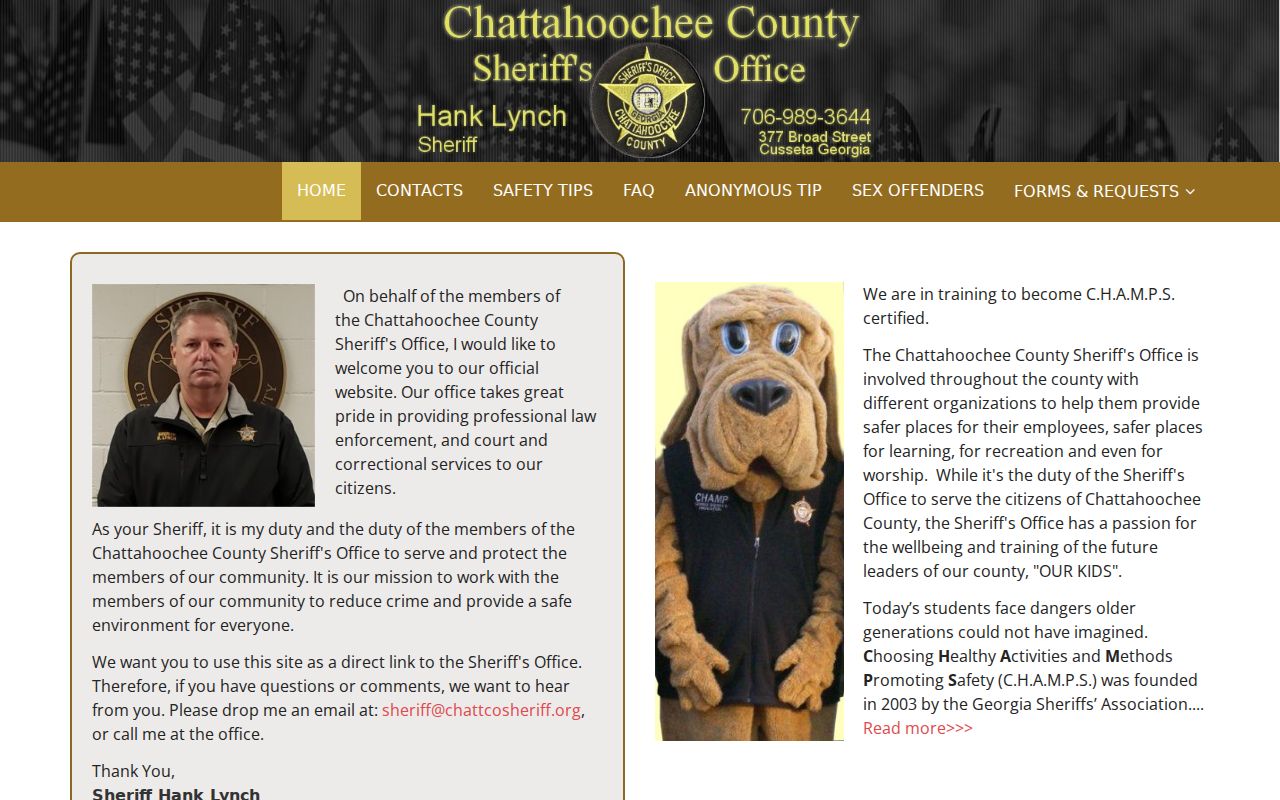
That combined role explains why the Cusseta record trail starts with the sheriff rather than a separate city police office.
The sheriff's official contacts page publishes its staff contacts and business hours.
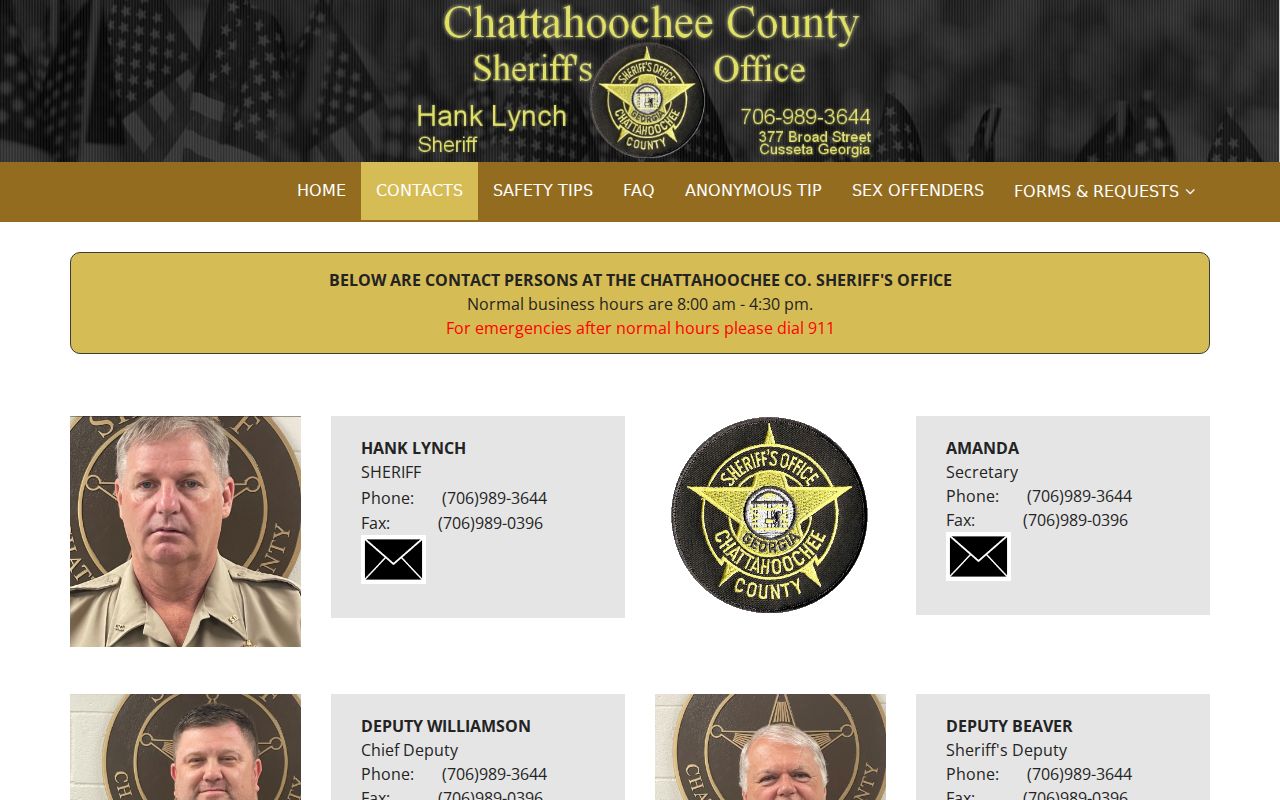
Use the current official listing to confirm the correct person and hours before sending a request.
A judge or prosecutor may work elsewhere in the six-county Chattahoochee Judicial Circuit, but the local Chattahoochee County file remains with the clerk in Cusseta. Call before traveling to confirm access, hours, identification, and device rules.
Georgia Official Background Checks
The Georgia Bureau of Investigation's Georgia Crime Information Center page identifies the state criminal-record programs.
GCIC is the state repository, but Georgia does not offer an unrestricted public GCIC name portal.
The GBI criminal-history FAQ explains record contents, inspection, and correction.
Under O.C.G.A. § 35-3-35 and local procedures, a Georgia law-enforcement agency can provide eligible name-based information. Chattahoochee County requesters should ask the sheriff about the current identification, consent, fee, and delivery rules because those details are not posted.
For authorized fingerprint checks, Fieldprint Georgia handles the Georgia Applicant Processing Service workflow.
A reason code and registration route may be required. No verified enrollment site lies inside Chattahoochee County, so use the live locator. GCIC also offers appointment-only personal record inspection in Decatur. The FBI Identity History Summary is a separate self-review of FBI-maintained data.
Chattahoochee County E-Access Routing
The clerk's case-search link and Georgia Courts E-Access do not form one free statewide database. E-Access is a directory to provider systems, and Chattahoochee Superior Court is listed. A provider account may be needed. Search labels, document images, and charges can vary by provider.
If a docket omits an image or looks incomplete, call the clerk at 706-989-3424. Ask for the case number, docket entries, disposition, and availability and cost of a certified copy. Court calendars give schedule context, not a complete history. The full process for pleadings and outcomes appears on the Chattahoochee County criminal court case page.
Superior Court has felony trial jurisdiction, while Magistrate Court handles warrants and preliminary matters. Chattahoochee County does not have a separately verified State Court listing in the reviewed sources, so the clerk should identify the correct court for a lesser charge. Seven shared superior judges serve the six-county circuit, which explains why a hearing officer's main office may be outside Cusseta even though the record belongs in Chattahoochee County.
Criminal Record Types
A Chattahoochee County criminal history is assembled from records created at different stages. The date and custodian often show what a result can prove.
- Incident and arrest report: the investigating agency's account of the event and alleged probable cause.
- Booking record: the sheriff's custody intake, fingerprints, photograph, initial charges, bond, and release or transfer data.
- Court file: accusations, indictments, motions, pleas, orders, judgments, and sentences kept by the clerk.
- GCIC history: matched Georgia arrest cycles and reported dispositions, subject to dissemination rules.
- Custody and supervision records: GDC, DCS, and parole sources that answer narrower state-status questions.
A warrant record may begin in Magistrate Court or arise as a bench warrant in Superior Court. Registry data is maintained centrally by GBI with local verification by the sheriff.
When Chattahoochee County Has No Roster
No official online Chattahoochee County inmate roster, arrest blotter, warrant search, or verified sheriff app was found. Call 706-989-3644 with a full name and approximate booking time. Ask whether the person is held, released, or transferred and request releasable booking, charge, bond, and court information.
The GDC Find an Offender search covers sentenced state offenders, not the county jail. A blank GDC result does not prove that a person was not recently booked in Chattahoochee County. Federal prisoners use the BOP locator, and VINELink can supplement notification where an agency participates. The official fallback chain and booking distinctions are detailed in the Chattahoochee County arrest lookup.
Inside a Chattahoochee County Criminal Record
The contents depend on which layer is open. Use the final court judgment to resolve a charge outcome, and treat personal identifiers carefully.
| Name & identifiers | Legal name, aliases, birth information, and physical descriptors where public and relevant. |
|---|---|
| Arrest / booking data | Agency, report and booking numbers, dates, alleged charges, custody, bond, holds, and release or transfer. |
| Charges & statutes | Initial arrest allegations and later prosecutor-filed counts, which may differ. |
| Disposition | Dismissal, plea, verdict, acquittal, nolle prosequi, or another final result. |
| Sentence | Confinement, probation, fines, conditions, and credit as stated in the judgment. |
| Custody / supervision | GDC incarceration, DCS supervision, or parole information within the source's scope. |
From Chattahoochee County Booking to GCIC
An arresting officer creates the incident and arrest report. For a fingerprintable arrest, booking staff establish identity, capture fingerprints and a photograph, and transmit required arrest-cycle and charge data through Georgia's criminal-justice network. The Chattahoochee County jail record describes custody, not guilt.
The prosecutor decides what to accuse or indict, and the clerk opens the judicial file. A court or other justice agency later reports the final disposition to GCIC. Timing gaps can leave a state history without an outcome even when the Chattahoochee County court has one. A certified disposition from the clerk is the key correction document.
Four records can therefore describe the same episode without being interchangeable. The arrest report states the officer's allegations. The booking sheet records intake and custody. The court docket shows the charge the prosecutor pursued. The GCIC history joins reportable arrest and disposition data. When two layers conflict, compare identifiers and dates, then ask the custodian of the authoritative source to correct its own entry.
Public Access Laws in Georgia
The Georgia Open Records Act favors access to existing public records, but exemptions protect active investigations, victims, juveniles, confidential identifiers, medical information, and sealed material. Criminal-history dissemination has separate limits. A focused request should name the event, record, date range, people, desired format, and a fee-approval ceiling.
Key statutes:
O.C.G.A. §§ 50-18-70 through 50-18-77 - governs access, response, cost, and exemptions for Georgia public records.
O.C.G.A. § 35-3-35 - controls dissemination of Georgia criminal-history information.
O.C.G.A. § 35-3-37 - provides record restriction and related court-file relief.
O.C.G.A. § 42-1-12 - establishes Georgia registration and public registry duties.
Fort Moore Changes the Record Trail
Geography does not always determine the custodian in Chattahoochee County. A sheriff arrest and state prosecution follow the Broad Street and Georgia paths. An event involving Fort Moore military police, a federal agency, or a federal prosecution may instead produce military investigative records, a federal FOIA or Privacy Act response, or a case in the U.S. District Court for the Middle District of Georgia.
PACER is the official federal docket system and may charge usage fees under its current schedule. The federal BOP locator is limited to federal custody. Neither source replaces the Chattahoochee County sheriff or clerk for a local case, and the local clerk will not necessarily hold a court-martial or federal prosecution.
The Middle District of Georgia website is the official federal district source for Chattahoochee County.
Use it for federal court locations and rules, while PACER remains the docket-access channel.
Sealed, Expunged, and Restricted Records
Georgia calls its main remedy record restriction. The official GBI restriction page provides the state process and older-arrest form.
Restriction limits ordinary public dissemination of qualifying GCIC information but does not destroy every government record. Court-file sealing under O.C.G.A. § 35-3-37(m), First Offender sealing, and a pardon are separate forms of relief with different effects.
The route depends in part on arrest date. For arrests before July 1, 2013, the official GCIC form follows the older agency and prosecutor process. For later arrests, requests ordinarily go to the prosecutor. An eligible court-file sealing request may still be needed after restriction. A person whose history lacks a disposition should first obtain the certified Chattahoochee County outcome and ask the court to transmit the correction.
Juvenile records and sealed judicial material follow additional access limits. Criminal-justice agencies may retain access to information that no longer appears in an ordinary public dissemination. That distinction matters when a Chattahoochee County search seems to change after relief. Keep the order, prosecutor response, and certified outcome, then check each system separately rather than assuming one approval updated every record at once.
Chattahoochee County Warrant Fallbacks
No verified public warrant database or app exists for Chattahoochee County. Confirm a local warrant through the sheriff at 706-989-3644 and the issuing court. Magistrate Court handles arrest and search warrants and preliminary matters; Superior Court can issue bench warrants in a felony case.
Active information can change quickly, and an unexecuted warrant or affidavit may be sealed. A request can seek a returned warrant, affidavit, docket entry, or bond order when public. Anyone resolving their own warrant should contact the issuing court or counsel for the warrant type, bond, surrender instructions, and calendar instead of relying on an anonymous result.
Chattahoochee County Sentence Supervision
The sentencing order at the Chattahoochee County clerk is the authoritative starting point for probation. The Georgia Department of Community Supervision handles adult felony probation and parole community supervision.
The Columbus Circuit office serves the area, but the court judgment states the sentence imposed.
The Georgia State Board of Pardons and Paroles makes parole decisions.
GDC covers state correctional custody, while Board and DCS sources answer different parole and supervision questions.
These are separate from the sheriff's county jail function. DCS officer notes are not a public dossier, and a GDC entry may not answer every current supervision question. Read the judgment, check the relevant state source, and use the serving DCS office for any public verification it can provide.
A violation may create several new entries: a DCS allegation, warrant or petition, revocation hearing, and court or Board outcome. The public trail is normally the filed docket and resulting order, not a broad release of supervision notes. For a misdemeanor sentence, the administering probation arrangement can depend on the sentencing court, so the judgment and clerk remain the best first sources.
Chattahoochee County Criminal Records by City
Chattahoochee County has one incorporated unified government, Cusseta–Chattahoochee County, rather than three separate city systems. There is no separate Cusseta police department or municipal-court portal. The sheriff provides local law-enforcement and correctional services, while the county clerk routes court records.
Cusseta Criminal Records
2025 estimate: 8,465 · Sheriff and county clerk channels serve the consolidated government.
Before closing a Chattahoochee County search, record the office contacted, date, case or booking number, and scope of each response. This prevents a jail-status answer from being mistaken for a lifetime history and reveals when a court disposition has not reached GCIC.
For personal review, compare the official history with the Chattahoochee County judgment one charge at a time. Keep restriction orders and correction correspondence. When a source cannot locate an item, verify the responsible agency and date before concluding that no record exists.