
Chattahoochee County Criminal Court Cases
The Clerk of Superior, Juvenile, and Magistrate Courts keeps the county's judicial files. Superior Court has exclusive felony-trial jurisdiction in Georgia. Magistrate Court issues arrest and search warrants, holds preliminary hearings, and handles other matters within its authority. Juvenile files have strict confidentiality rules. The official local site does not advertise a separate Chattahoochee State Court, so a misdemeanor or traffic seeker should ask the clerk which court owns the file instead of assuming a docket exists.
A criminal court file begins after a charging document reaches a court. It may contain a returned warrant, accusation or indictment, hearing notices, motions, plea papers, orders, judgment, and sentence. The docket is the dated index to those events. It does not merely repeat a booking sheet. Prosecutors may reduce, replace, merge, or decline an initial arrest charge before filing.
Chattahoochee Courts Divide Case Work
Court level matters when locating a Chattahoochee County criminal case. Felony trials belong in Superior Court. Magistrate Court handles warrants and early proceedings, including preliminary hearings. The same clerk administers those records from the courthouse in Cusseta. That shared counter simplifies routing, but it does not make the files interchangeable.
| Court or office | Criminal-record role |
|---|---|
| Superior Court | Felony filings, pleas, trials, judgments, and sentences |
| Magistrate Court | Warrants, first-stage proceedings, and preliminary hearings |
| Juvenile Court | Delinquency matters with restricted public access |
| Local clerk | Dockets, copies, older files, and certified dispositions |
The sheriff holds the arrest report and booking layer. Once charges are filed, the clerk's case record is the stronger source for the formal charge and final result. The county's broader record routes are summarized on the Chattahoochee County criminal history page.
Searching Chattahoochee County Case Records
Begin with the official Chattahoochee clerk site and its Case Search navigation. Georgia Courts also lists Chattahoochee Superior in E-Access to Court Records. E-Access is a directory to participating providers, not one free statewide database. A provider account may be required, and docket images may have separate access terms.
| Search control | How to use it |
|---|---|
| Court by county | Select Chattahoochee Superior from the linked court list |
| Provider account | Follow the selected provider's registration or login process |
| Case criteria | Use case number when known; otherwise start with legal name and filing year |
| Result review | Match court, county, party, filing date, and charge before relying on a hit |
Search names with care. A shared name is not enough to identify a defendant. Verify the case number, filing year, court, and charge. If the provider lacks an image, disposition, or old entry, call the clerk rather than treating the missing screen as proof that no case exists.
Chattahoochee Certified-Disposition Fallback
The local fallback is the clerk at 379 Broad Street, P.O. Box 120, Cusseta, GA 31805. The listed telephone is 706-989-3424 and fax is 706-989-1945. Ask for a docket, a named filing, or a certified disposition. Specific requests are easier to route than a demand for every paper tied to a name.
A certified disposition is a compact court-certified statement of how a charge ended. It is useful when a provider page shows no final result or when a GCIC history lacks a matched outcome. Give the clerk the case number if possible, plus the defendant's legal name and approximate filing year. Confirm current copy, certification, payment, and delivery rules before sending funds because the research found no published criminal-copy fee schedule.
Inside a Chattahoochee County Case File
A Chattahoochee County criminal case record can expose procedural facts that never appear in a jail entry. Availability varies by file and access order. Sensitive identifiers, victim details, sealed documents, juvenile material, and grand-jury records may be removed from public view.
| Case identity | Case number, caption, court, filing date, case type, status, and assigned judge |
|---|---|
| People | Party names, counsel, and other public role information |
| Charges | Charge text, cited statute, accusation or indictment date, and later amendments |
| Docket | Dated event descriptions, motions, notices, orders, and hearings |
| Outcome | Plea or trial result, disposition by charge, judgment, and sentence |
| Documents | Images when authorized and available through the provider or clerk |
Read the docket in sequence. An indictment is a formal charge, not a finding of guilt. A plea records the defendant's answer or negotiated resolution. The judgment and sentence state the court's final action. One case may end differently for each count.
Chattahoochee Criminal Cases Share Judges
Chattahoochee County belongs to the six-county Chattahoochee Judicial Circuit with Harris, Marion, Muscogee, Talbot, and Taylor counties. Superior judges and the district attorney serve across that circuit, while the Chattahoochee clerk keeps the local county file. A judge or prosecutor may therefore have a Columbus office even though the record belongs at the Cusseta counter.
Use the official circuit court site to confirm the current bench and circuit routing. The local clerk's calendar can help with schedule context, but a calendar is not a full docket. Hearing dates can change. Parties and those with immediate case duties should verify the next setting directly with the proper office.
How a Criminal Case Moves
The case trail normally grows in stages. Arrest and booking may occur first, but the court identity starts with a filed charge. An arraignment gives the defendant a formal opportunity to answer. Pretrial work can include discovery, motions, bond review, and negotiations. A plea or trial then resolves contested charges, followed by disposition and any sentence.
Case flow: Charges Filed › Arraignment › Pretrial › Plea or Trial › Disposition › Sentencing
Not every Chattahoochee County case uses every step. Charges can be dismissed or not pursued. Counts can change. A dead docket pauses prosecution without creating a conviction, while a nolle prosequi reflects the prosecutor's decision not to proceed on that charge at that time. The final judgment must control over an old booking label.
Reading Chattahoochee Case Outcomes
Disposition words should be read in context. “Dismissed” means the court ended that charge without a conviction. “Nolle prossed” means the prosecutor chose not to pursue it. “No bill” means the grand jury did not return an indictment on the matter presented. “Not guilty” or “acquitted” records a favorable trial result. First Offender treatment is a Georgia sentencing status, not a separate crime class.
A blank disposition is not the same as guilty. It may show a reporting delay, provider gap, or unmatched court outcome. Obtain the certified result from the Chattahoochee County clerk, then follow GCIC correction guidance if the state history remains incomplete.
Fort Moore Federal Case Detour
Geography near Fort Moore creates a real jurisdiction fork. An event tied to the installation may produce a federal or military record instead of a Chattahoochee County prosecution. Federal criminal cases for the area belong to the U.S. District Court for the Middle District of Georgia. County E-Access will not supply those filings.
The official PACER system provides federal dockets and documents after registration, subject to its current fee terms. Its interface is shown below. A federal docket can list the indictment, appearances, detention orders, motions, plea, judgment, and sentence.
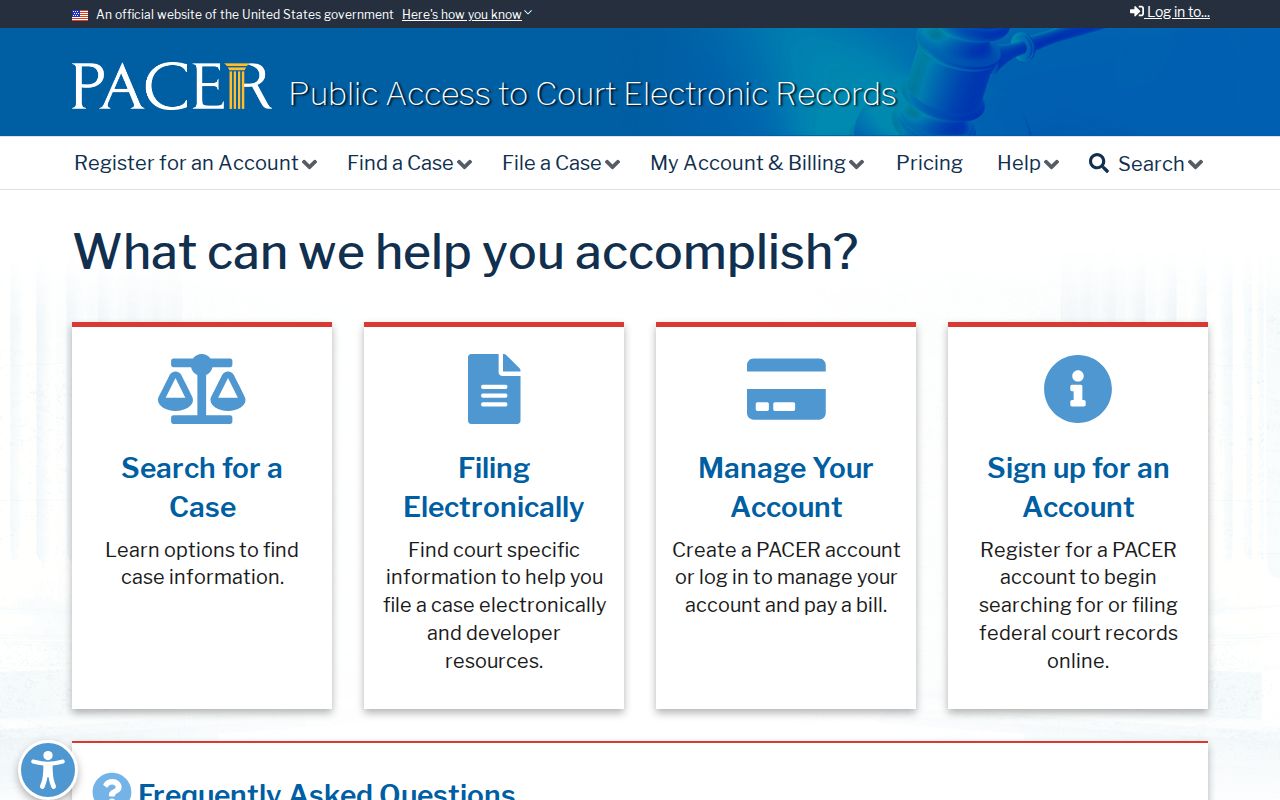
This federal route should be used only when the court or originating agency is federal. Military administrative or court-martial files may require the responsible military channel instead.
Case Record Access and Restrictions
Public court access has limits. Juvenile matters, sealed documents, protected victim information, confidential identifiers, and grand-jury material may not appear. An online omission also can mean an old paper file, an indexing error, or a provider image limit. The clerk cannot disregard a judicial sealing order.
Georgia's Open Records Act governs many agency documents, but court files follow clerk procedures, court rules, common-law access principles, and sealing orders. Ask the clerk for a specific docket or document using the case number and title. If access is denied, ask whether the record is sealed, restricted, undigitized, or simply unavailable through the provider. That distinction identifies the proper next step.
The official state provider screen is available through Georgia E-Access, shown here as the routing layer for Chattahoochee Superior.
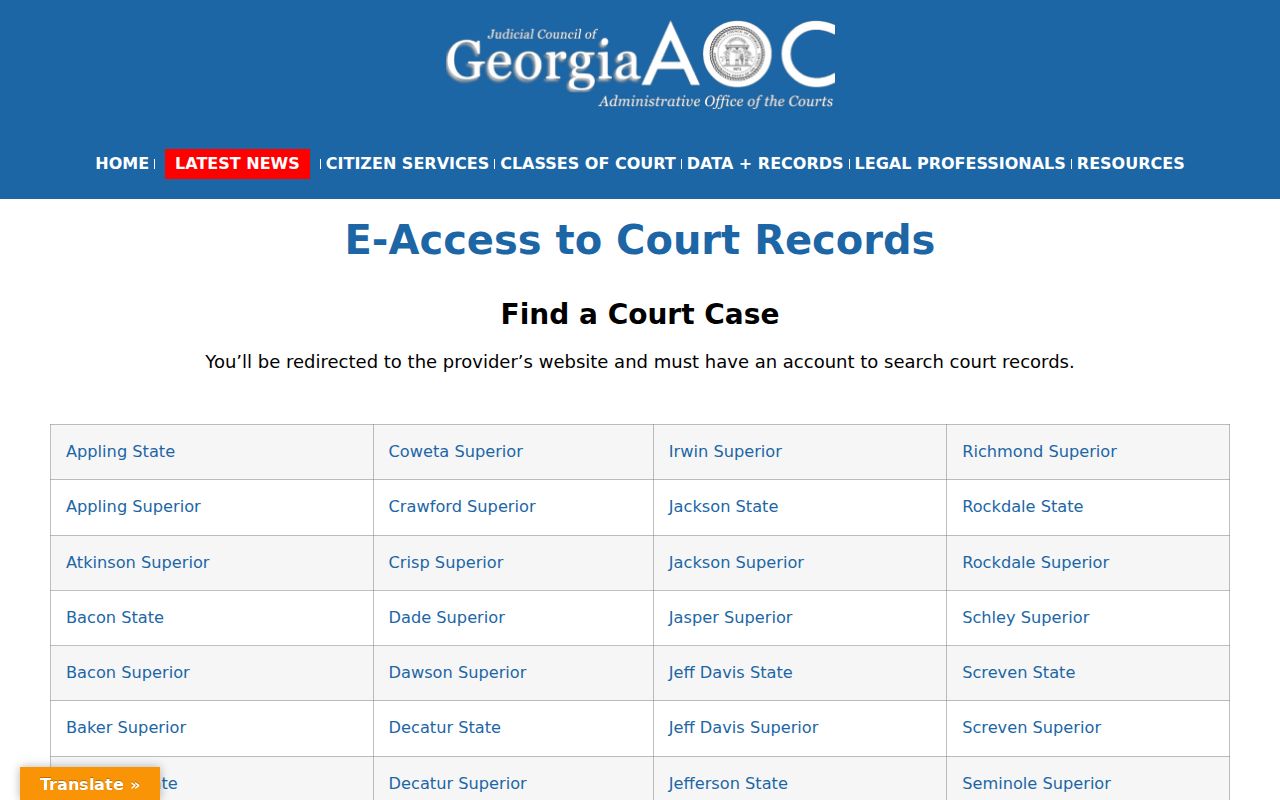
The image reinforces the key limit: the state page routes the search to a provider and does not itself function as one unified county case database.
Before relying on a Chattahoochee County docket, compare the caption, case number, court, filing date, and party identifiers. A calendar entry only shows that a matter was scheduled. It does not establish what occurred at the hearing or how the charge ended. Ask the clerk for the docket entry and signed order when a provider summary is unclear.
Certified copies serve a different purpose from screen results. If the outcome has not reached GCIC, keep the certified judgment and ask the court about transmitting the disposition. That addresses the mismatch instead of treating an incomplete repository entry as the final Chattahoochee County case record.